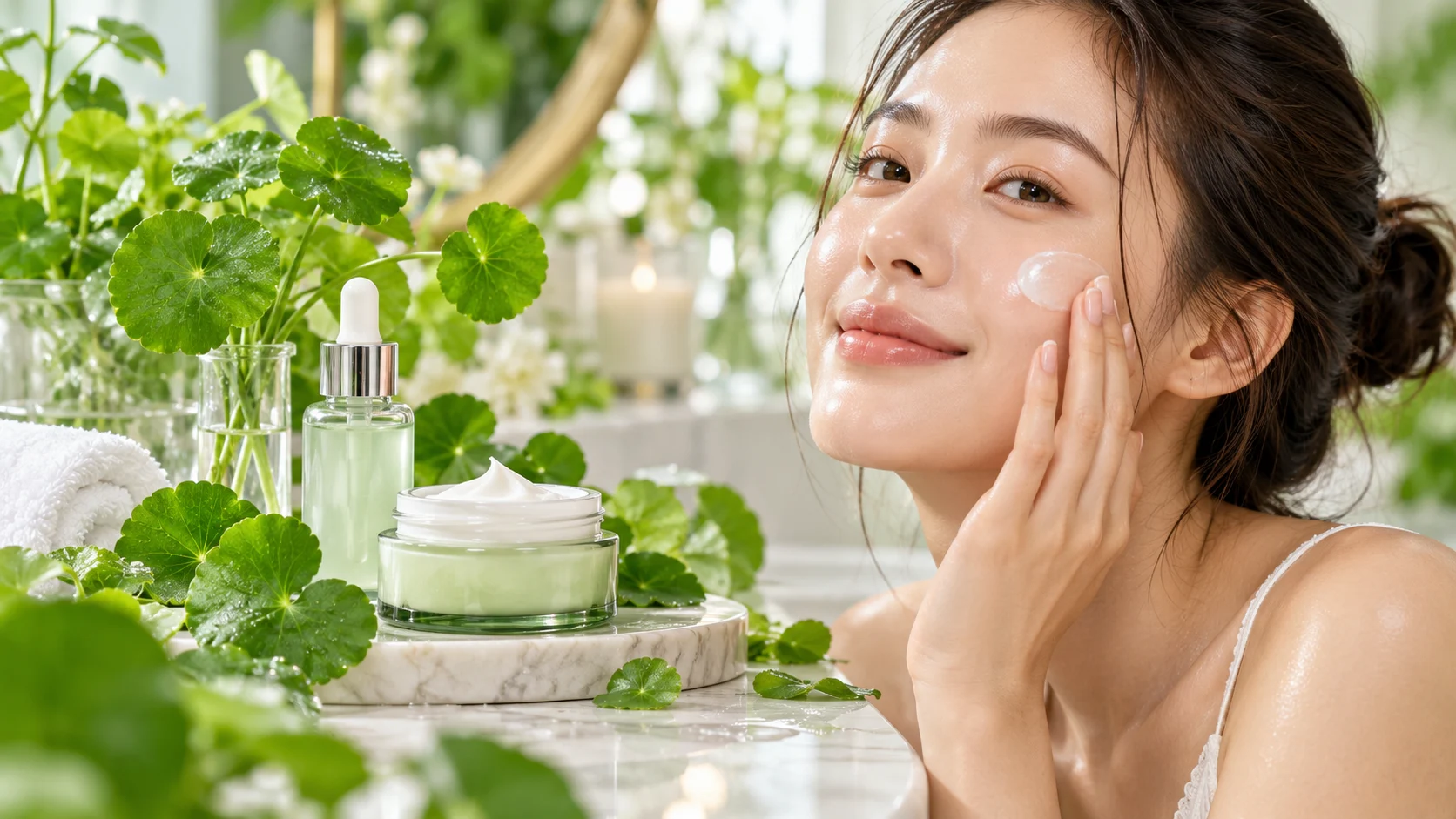
Centella asiatica has become a popular skincare ingredient because of its soothing, moisturizing, and skin-supporting properties. Commonly known as Cica or Gotu Kola, this botanical ingredient appears in serums, moisturizers, toners, and face masks. Many skincare enthusiasts appreciate Centella asiatica for its potential to calm temporary redness, support the skin barrier, and improve overall skin comfort.
The growing popularity of Korean skincare has helped introduce Centella asiatica to a wider audience. Unlike some ingredients that focus primarily on exfoliation or skin renewal, Centella is often included in products designed for gentle daily care. Its naturally occurring compounds have been studied for their antioxidant, anti-inflammatory, and skin-repairing properties, although results vary between formulations.
Understanding Centella asiatica benefits for skincare can help you decide whether this ingredient belongs in your routine. This guide explains what Centella asiatica is, how it works, its potential benefits for different skin types, and how to use it safely. It also explores Cica products, compatible skincare ingredients, possible side effects, and common mistakes to avoid.
What Is Centella Asiatica in Skincare?
Centella asiatica is a small herbaceous plant that grows in tropical and subtropical regions of Asia and other parts of the world. It has a long history of use in traditional herbal practices. Today, extracts from the plant are widely included in cosmetic and skincare formulations. The ingredient is particularly popular in products marketed for sensitive or uncomfortable skin.
In skincare, Centella asiatica is often referred to as Cica or Gotu Kola. Its extracts contain naturally occurring compounds called triterpenes, including madecassoside, asiaticoside, asiatic acid, and madecassic acid. These compounds have attracted scientific interest because of their potential effects on inflammation, collagen production, and skin repair. Their activity depends on the formulation and concentration.
Centella asiatica is found in different skincare products, including lightweight serums, hydrating creams, and soothing toners. Some formulations contain whole plant extracts, while others use isolated compounds such as madecassoside. Product quality and additional ingredients influence how a formula performs. Understanding these differences helps consumers make informed skincare decisions.
How Does Centella Asiatica Work on the Skin?
Centella asiatica contains bioactive compounds that have been investigated for their effects on skin function. Laboratory and clinical research suggests that certain components may influence processes associated with inflammation and tissue repair. These findings help explain why Centella appears in soothing skincare products. However, not every cosmetic formula has the same demonstrated benefits.
Madecassoside and asiaticoside are two particularly well-known compounds found in Centella asiatica. Research has explored their antioxidant activity and possible contribution to collagen-related processes. These mechanisms may support skin recovery under certain conditions. Nevertheless, evidence from laboratory experiments does not automatically establish equivalent results from everyday cosmetic use.
Centella skincare products often combine botanical extracts with moisturizers and other barrier-supporting ingredients. The complete formula may help skin retain moisture and feel more comfortable. Therefore, improvements cannot always be attributed to Centella alone. The most reliable approach is to evaluate the entire product rather than focusing exclusively on one ingredient.
1. Centella Asiatica May Help Soothe Irritated Skin
One of the most recognized Centella asiatica benefits is its potential to soothe skin experiencing temporary discomfort. Its naturally occurring compounds have been investigated for their anti-inflammatory properties. This makes Centella a common ingredient in products intended for delicate or easily irritated skin. However, individual responses vary.
Temporary irritation may occur because of environmental conditions, frequent cleansing, or unsuitable skincare products. A well-formulated soothing cream can help improve comfort while supporting the skin’s natural protective functions. Centella-containing products may be useful in this context. They should not be considered substitutes for medical treatment when significant irritation is present.
When choosing a soothing product, examine the complete ingredient list. Added fragrance, essential oils, or strong exfoliating ingredients may cause irritation in some people. A simple formulation may be easier to tolerate. Testing a small area before regular use is advisable, especially for sensitive skin.
2. Supports the Skin’s Natural Moisture Barrier
The skin barrier is the outer protective layer that helps retain moisture and limit exposure to environmental irritants. When this barrier becomes disrupted, skin may feel dry, tight, or uncomfortable. Centella asiatica is frequently included in skincare products designed to support barrier function. Its potential benefits remain an active area of research.
Moisturizing formulas containing Centella may also include ingredients such as glycerin, ceramides, and hyaluronic acid. These components help maintain hydration through different mechanisms. The combination can be useful for everyday barrier care. However, the effectiveness depends on the concentrations and overall design of the product.
Maintaining a comfortable skin barrier also involves gentle cleansing and avoiding unnecessary product irritation. A skincare routine does not need many steps to be effective. Consistent moisturizing may provide greater benefits than frequently changing products. Centella can be considered one supportive ingredient within this broader approach.
3. May Reduce the Appearance of Temporary Redness
Temporary facial redness can occur because of environmental exposure, friction, dryness, or reactions to skincare products. Centella asiatica is often used in formulations intended to improve visible skin comfort. Its potential anti-inflammatory properties may help explain this use. However, persistent redness can have several underlying causes.
A lightweight Centella serum or moisturizing cream may help some people manage temporary redness associated with dryness or mild irritation. The product’s additional ingredients also influence its performance. Gentle application and suitable moisturization are important. Results are not guaranteed and may vary between individuals.
Redness that persists, spreads, or occurs with significant burning or swelling should not be managed solely through cosmetic products. A dermatologist can help identify possible causes and recommend appropriate care. Centella skincare products are supportive rather than diagnostic treatments. Understanding this distinction helps set realistic expectations.
4. Provides Antioxidant Support
Antioxidants help protect biological structures against damage associated with oxidative stress. Centella asiatica contains compounds that have demonstrated antioxidant activity in experimental research. This characteristic has contributed to its popularity in modern skincare. However, laboratory antioxidant findings do not necessarily predict visible cosmetic results.
Environmental factors such as ultraviolet radiation and pollution can contribute to oxidative processes in the skin. Skincare products containing antioxidants may provide additional supportive benefits, depending on their formulation. Centella is sometimes combined with other antioxidant ingredients. The effectiveness of these combinations requires appropriate product testing.
Antioxidant skincare should not replace established protective habits. Broad-spectrum sunscreen, sensible sun exposure, and gentle daily care remain important. A Centella serum may complement these practices. Its role is best understood as part of an overall skincare routine rather than a standalone protective solution.
5. May Support Skin Repair Processes
Centella asiatica has a long history of investigation for its potential role in skin repair and wound-related processes. Some studies suggest that its triterpene compounds may influence collagen synthesis and other biological activities involved in tissue recovery. This research has contributed to the development of specialized topical formulations. However, evidence varies by product and application.
Ordinary cosmetic products containing Centella should not be assumed to have the same effects as medical wound-care preparations. Concentration, delivery methods, and testing standards can differ substantially. A moisturizing cream may improve comfort without treating a skin injury. Product labels should be interpreted carefully.
Open wounds, significant burns, and infected skin require appropriate medical care rather than ordinary cosmetic experimentation. Centella-containing moisturizers may be useful for intact skin when tolerated. Their benefits should be considered in the context of the complete formulation. Realistic expectations help avoid overestimating what a skincare ingredient can accomplish.
6. Helps Maintain Skin Hydration
Hydration is important for keeping skin comfortable and supporting its normal protective functions. Centella asiatica frequently appears in hydrating serums, creams, and lotions. These products may help improve moisture retention when combined with effective moisturizing ingredients. The amount of hydration provided depends on the complete formula.
Ingredients such as glycerin and hyaluronic acid attract water, while emollients and occlusives help reduce moisture loss. Centella may complement these components through its soothing properties. This combination can be useful for skin that feels dry or uncomfortable. However, Centella extract alone is not necessarily a complete moisturizer.
People with dry skin may prefer richer formulations containing suitable moisturizing ingredients. Those who enjoy lighter textures may choose gels or serums followed by a moisturizer. The best approach depends on personal comfort and product tolerance. Consistent hydration often matters more than using a particular trendy ingredient.
7. May Improve the Appearance of Fine Lines
Centella asiatica compounds have been studied for their possible influence on collagen-related biological processes. Collagen is an important structural protein that contributes to skin strength and flexibility. These findings have generated interest in Centella as an ingredient in age-related skincare. However, strong clinical evidence for dramatic wrinkle reduction from ordinary products is limited.
Skin that is adequately moisturized may temporarily appear smoother because surface dryness becomes less noticeable. Centella-containing moisturizers can contribute to this effect when their formulations provide sufficient hydration. This is different from reversing structural skin changes. Marketing claims should be evaluated carefully.
Everyday skincare does not need to focus on preventing all visible signs of aging. Gentle cleansing, adequate hydration, and sun protection support general skin health at different ages. Centella can be included when it suits your skin. Its potential benefits should not be treated as a guarantee of major appearance changes.
8. Is Centella Asiatica Good for Sensitive Skin?
Centella asiatica is commonly included in skincare products marketed for sensitive skin. Its soothing reputation makes it appealing to people who experience occasional discomfort from cosmetic products. Some individuals find these formulas comfortable to use. However, sensitive skin can react to almost any ingredient, including botanical extracts.
A product containing Centella may also include fragrances, preservatives, exfoliating acids, or other ingredients. These additional components can influence whether the product causes irritation. Choosing a simple, fragrance-free formula may be helpful for people prone to reactions. The label matters more than the presence of one popular ingredient.
Patch testing is especially important when introducing a new skincare product. Apply it to a small area according to appropriate testing guidance before using it more widely. Discontinue use if significant irritation develops. A dermatologist can provide advice when skin sensitivity is persistent or difficult to manage.
9. Can Centella Asiatica Help Acne-Prone Skin?
Centella asiatica may be appealing to people with acne-prone skin because it is associated with soothing and skin-barrier support. Acne treatments can sometimes cause dryness or irritation, making gentle moisturization important. A well-formulated Centella product may help support comfort alongside an appropriate skincare routine. However, it is not an established standalone acne treatment.
Acne develops through several processes involving clogged pores, oil production, and inflammation. Centella does not replace evidence-based acne treatments when these are needed. Its potential anti-inflammatory activity does not mean it can reliably prevent or clear breakouts. Claims promising rapid acne elimination should be viewed cautiously.
For acne-prone skin, select products that suit your individual needs and avoid ingredients that repeatedly cause discomfort. A non-comedogenic moisturizer may be useful when tolerated. Persistent or painful acne deserves professional guidance. Gentle skin support can complement treatment without replacing it.
10. Can Centella Asiatica Help With Acne Marks?
Post-acne marks can include temporary discoloration that remains after blemishes have settled. These marks differ from permanent textural scarring and may improve gradually over time. Centella asiatica has been investigated for processes related to skin repair, which has generated interest in its use for post-acne skin. However, clinical evidence for removing acne marks is limited.
A soothing moisturizer may help maintain skin comfort while discoloration gradually changes. It should not be expected to erase dark spots or raised and depressed scars. Different forms of post-acne marks require different approaches. Identifying the type of concern is important before choosing products.
Sun protection can help prevent some forms of post-inflammatory discoloration from becoming more noticeable. People with persistent marks may benefit from advice from a dermatologist. Avoid harsh experiments or repeated product changes. A gentle routine and realistic expectations are more useful than assuming every botanical ingredient provides scar correction.
11. Centella Asiatica for Dry Skin
Dry skin often benefits from moisturizing products that help reduce water loss and improve comfort. Centella asiatica may be included in creams designed for this purpose. Its soothing properties can complement richer moisturizing ingredients. However, the product’s texture and barrier-supporting components determine much of its effectiveness.
People with dry skin may prefer creams containing ingredients such as glycerin, ceramides, or petrolatum alongside Centella. These ingredients help support moisture retention in different ways. Lightweight Centella toners may feel refreshing but might not provide sufficient moisturization alone. Choosing a complete formulation is important.
Dryness can also worsen because of frequent washing, harsh cleansers, or environmental conditions. Using gentle cleansing products and appropriate moisturizers may help maintain comfort. Persistent cracking, severe itching, or painful irritation deserves professional assessment. Centella is best viewed as a supportive option rather than a universal solution.
12. Centella Asiatica for Oily and Combination Skin
Oily and combination skin can still benefit from moisturization and gentle skincare. Excess oil production does not necessarily mean the skin has adequate water content or barrier support. Centella is frequently used in lightweight gels and serums suited to different skin preferences. These products may offer a comfortable texture without feeling especially heavy.
A water-based Centella serum may fit into a simple routine when followed by an appropriate moisturizer. However, the ingredient itself does not guarantee that a product will control excess oil. Other components determine how the formula feels and performs. Labels such as lightweight or non-comedogenic may help guide product selection.
Combination skin can have different needs across the face. Some areas may feel oily while others become dry or uncomfortable. Choosing gentle products that work across these areas can simplify skincare. Adjustments should be based on actual skin response rather than assumptions about a particular skin type.
13. How to Use Centella Asiatica in Your Skincare Routine
Centella asiatica can be incorporated into a skincare routine through a serum, moisturizer, toner, or other cosmetic product. The exact order depends on the formulation and product instructions. A simple routine often starts with gentle cleansing, followed by suitable skincare products. Morning routines should also include broad-spectrum sunscreen.
If using a lightweight Centella serum, it is commonly applied before a thicker moisturizer. A Centella cream may serve as the moisturizing step itself. There is usually no need to apply several different Centella products simultaneously. Choosing one suitable formula makes it easier to evaluate skin tolerance.
Introduce new products gradually and observe how your skin responds. Some people tolerate Centella well, while others may experience irritation from the extract or other ingredients. Consistency is useful, but discomfort should not be ignored. A simple routine can provide effective everyday care without unnecessary complexity.
14. Can You Use Centella Asiatica Every Day?
Many Centella-containing cosmetic products are formulated for regular use. Whether daily application is appropriate depends on the complete ingredient list and your individual skin response. A basic moisturizing cream may be suitable for frequent use, while a formula containing stronger active ingredients may require different guidance.
Beginners should follow the product’s directions rather than assuming that frequent application produces faster results. Introducing one new product at a time can make reactions easier to identify. Skin that becomes uncomfortable may benefit from a simpler routine. More skincare is not always better.
If a product is well tolerated, consistent use may help maintain the moisturizing and soothing benefits of its formulation. However, noticeable results vary, and there is no universal timeline. Skin concerns that persist or worsen should be assessed appropriately. Everyday use should prioritize comfort and safety.
15. Centella Asiatica vs. Hyaluronic Acid
Centella asiatica and hyaluronic acid serve different roles in skincare. Centella is primarily associated with soothing and potential barrier-supporting properties, while hyaluronic acid is a humectant that helps attract and retain water. Both appear in moisturizing products. They are not direct replacements for one another.
Hyaluronic acid can be useful when the main goal is improving surface hydration. Centella-containing products may appeal to people seeking gentle formulas for skin comfort. Some moisturizers combine both ingredients to address several needs. The effectiveness depends on the complete product rather than the ingredient names alone.
| Feature | Centella Asiatica | Hyaluronic Acid |
|---|---|---|
| Main skincare role | Soothing and skin support | Water-binding hydration |
| Ingredient origin | Botanical extract or isolated compounds | Naturally occurring molecule, often produced through fermentation |
| Common products | Serums, toners, creams | Serums, lotions, creams |
| Best-known benefit | Potential skin comfort support | Improving skin hydration |
| Suitable skin types | Depends on formulation | Depends on formulation |
Using both ingredients can be reasonable when they are included in a well-formulated product. However, layering multiple serums is not always necessary. Choose products based on actual skin needs and tolerance. A balanced routine should remain straightforward and comfortable.
16. Centella Asiatica vs. Niacinamide
Centella asiatica and niacinamide are commonly found in modern skincare products. Niacinamide is a form of vitamin B3 associated with supporting skin barrier function and addressing certain appearance-related concerns. Centella is a botanical ingredient studied for soothing and repair-related mechanisms. Their functions can overlap, but their evidence bases and formulations differ.
Niacinamide appears in products intended for hydration, uneven tone, and general barrier care. Centella may complement these products when skin comfort is a priority. Some formulations combine both ingredients. However, a higher number of active ingredients does not automatically produce better results.
People with sensitive skin should consider the complete formula and ingredient concentrations. Even generally well-tolerated ingredients can cause discomfort in some circumstances. Patch testing and gradual introduction help identify suitable products. Choosing one balanced moisturizer may be simpler than layering several different treatments.
17. Can You Use Centella Asiatica With Retinol or Vitamin C?
Centella asiatica can appear in skincare routines that include ingredients such as vitamin C or retinoids. There is no universal incompatibility between Centella and these ingredients. However, product tolerance varies, especially when stronger formulations are used. The overall skincare routine should be appropriate for the individual’s needs.
Retinoids and some vitamin C formulations may cause irritation in certain people. A gentle Centella-containing moisturizer might support skin comfort, but it cannot guarantee prevention of irritation. New active ingredients should not be introduced all at once. Following product guidance is particularly important with stronger treatments.
For young or sensitive skin, complicated anti-aging routines are usually unnecessary. Gentle cleansing, moisturizing, and sun protection are often sufficient for everyday skin care. If a prescription treatment has been recommended, follow the prescribing professional’s instructions. Centella should not be used to justify ignoring irritation from another product.
18. Side Effects and Precautions of Centella Asiatica
Centella asiatica is generally considered a familiar cosmetic ingredient, but natural origin does not guarantee safety for everyone. Some people may experience irritation, itching, redness, or an allergic skin reaction. Additional ingredients within the same product may also contribute to discomfort. Individual tolerance is therefore important.
Before using a new Centella product widely, test it on a small area according to dermatological guidance. If irritation develops, stop using the product and gently cleanse the affected area. Seek professional advice for persistent or severe reactions. Avoid applying ordinary cosmetics to open wounds or significantly damaged skin without medical guidance.
People with diagnosed skin conditions should not assume that Centella can replace prescribed treatments. Cosmetics and medical preparations have different purposes and evidence requirements. Product labels may also use marketing language that overstates potential benefits. Choosing reputable formulations and setting realistic expectations supports safer skincare decisions.
How to Choose the Best Centella Asiatica Skincare Product
Choosing a Centella asiatica product starts with identifying your main skincare needs. Someone seeking lightweight hydration may prefer a serum or gel, while dry skin may benefit from a richer cream. Texture, additional moisturizing ingredients, and fragrance content can influence product suitability. The botanical ingredient alone does not determine effectiveness.
Review labels for terms such as Centella asiatica extract, madecassoside, and asiaticoside. These indicate the presence of the plant extract or particular associated compounds. However, ingredient names do not reveal the full quality or clinical effectiveness of a formula. Product concentration and testing information may also be limited.
Avoid assuming that high percentage claims always indicate a better product. The meaning of an extract percentage depends on how the extract was prepared and measured. A balanced formulation may perform better than a highly concentrated one. Testing compatibility and considering skin comfort are more useful than focusing entirely on marketing claims.
Conclusion
Centella asiatica is a widely used skincare ingredient valued for its potential soothing, antioxidant, and skin-supporting properties. Its naturally occurring compounds, including madecassoside and asiaticoside, have been studied for their role in biological processes related to inflammation and repair. These findings help explain its popularity in modern skincare. However, results from everyday cosmetic products depend on their formulations.
Centella-containing serums, toners, and moisturizers may support skin comfort and hydration when used appropriately. The ingredient can be incorporated into simple routines for different skin types, although individual tolerance varies. It is not a guaranteed treatment for acne, persistent redness, scars, or other medical skin conditions. Choosing suitable products and reviewing ingredients remains important.
Understanding Centella asiatica benefits for skincare can help you make more informed decisions about your routine. Start with a gentle formula, introduce new products carefully, and pay attention to how your skin responds. Combine suitable skincare with consistent moisturization and sun protection. With realistic expectations, Centella can be a useful optional ingredient for everyday skin care.
Frequently Asked Questions
What does Centella asiatica do for your skin?
Centella asiatica is associated with soothing, antioxidant, and skin-supporting properties. Products containing it may help improve skin comfort and hydration, although benefits depend on the overall formulation and individual tolerance.
Is Centella asiatica good for acne-prone skin?
Centella may help support skin comfort when acne treatments cause dryness or irritation. However, it is not a proven standalone acne treatment and should not replace appropriate medical care.
Can I use Centella asiatica every day?
Many Centella skincare products are designed for daily use. Follow the product instructions, introduce it gradually, and stop using it if irritation or an allergic reaction develops.
Is Centella asiatica better than niacinamide?
Neither ingredient is universally better. Centella is commonly used for soothing skincare, while niacinamide has evidence supporting several barrier and cosmetic benefits. The best choice depends on individual needs and formulation.
How long does Centella asiatica take to work?
Results vary by product and skin concern. A moisturizing formula may improve comfort relatively quickly, while other potential effects are less predictable. There is no guaranteed timeline for visible improvement.



[…] Centella Asiatica Benefits for Skincare […]